Saturday, August 9, 2025

Upadesa Undiyar: Verse 19, 20, 30


If one keenly investigates what is the awareness that now shines as ‘I’, then in [one’s] heart a kind of sphurippu (an awareness [prajñā] of one’s own existence that is limitless and endowed with a fresh clarity, distinct from the limited body-awareness called ‘I’) alone will appear itself to itself [oneself to oneself] without sound as ‘I am I’. 

As soon as the mind reaches the heart [its core and essence, which is pure awareness] [by] inwardly investigating who am I, when [thereby] he who is ‘I’ [ego] dies, one thing [or the one] appears spontaneously [or as oneself] as ‘I am I’ [that is, as awareness of oneself as oneself alone]. 

Though it appears, it is not ‘I’ [namely ego]. It is pūṉḏṟam [the whole or pūrṇa, which is infinite, eternal and unchanging], the poruḷ [the real substance or vastu] that is oneself. (Uḷḷadu Nāṟpadu verse 30) 

When one investigates within [or inwardly investigates] what the place is from which one [or it] rises as ‘I’ [ego or mind], ‘I’ will die. This is jñāna-vicāra [awareness-investigation]. (Upadēśa Undiyār verse 19) 

In the place where ‘I’ [namely ego, the false awareness ‘I am this’] merges, that, the one, appears spontaneously [or as oneself] as ‘I am I’. That itself [or that, oneself] is pūṉḏṟam [pūrṇa: the infinite whole or entirety of what is]. (Upadēśa Undiyār verse 20) 

Thus Spake Ramana

2. Reality is at once Being and Consciousness. To know That is to be That in the Heart, transcending thought. Absolute surrender to the Supreme Lord, whereby the 'I' and 'mine' are destroyed, is the one means to realize Immortality. The Supreme Being, the one the supreme method of attainment

10. You say that this is the ‘age of reason’ and that the teaching must be in accordance with reason. I ask: ‘Whose is the intellect?’ You must answer ‘My intellect’. So the intellect is your tool. You use it for measuring variety. It is not yourself nor is it something independent of yourself. You are the abiding reality, while the intellect is just a phenomenon. You must find and get hold of yourself. 

There is no intellect in dreamless sleep. There is none in a child. The intellect develops with age. But how could there be any development or manifestation of the intellect without the seed of it in sleep or childhood? 

Why go to history to discover this fundamental fact? The degree of truth in the history is the same as the degree of truth in the historian.

12. This world, which you try to prove to be real, is all the time mocking at you for seeking to know it, without first knowing yourself. How can the knowledge of objects arising in relative existence to one who does not know the truth of himself, the knower, be true knowledge? If one rightly knows the truth of him named I', in whom both knowledge and its opposite subsist, then along with ignorance relative knowledge also will cease.

13. The world and the mind arise and set together as one; but of the two, the world owes its appearance to the mind alone; That alone is real in which this (inseparable) pair, the world and the mind, has risings and settings; that Reality is the one infinite Consciousness, having neither rising nor setting.

17.⁠ ⁠When the sense of 'I am the body' arises then the notions of 'you and 'he' also arise; but when, by the quest of the Truth underlying the 'I', the 'I' sense is put an end to, then the notions of 'you' and 'he' also cease. That which then shines as the sole remainder is the true Self.

20.⁠ ⁠The mind is nothing but the stream of thoughts, that passes over Consciousness. Of all these thoughts, the first one is the thought, 'I am this body'. This is a false thought; but because it is taken as true, it is possible for other thoughts to arise. So the mind is just an outgrowth of the primary ignorance and is therefore unreal.

23. If the inquiry is made whether mind exists, it will be found that mind does not exist. That is control of mind. Otherwise if the mind is taken to exist and one seeks to control it, it amounts to the mind controlling the mind, just like a thief turning out as a policeman to catch the thief, that is himself.

24. This insentient body does not say 'I'; no one ever says 'I did not exist in sleep'; but all this comes into being only after the rising of the ego; seek therefore the Source wherefrom the ego rises, by concentrating the mind on the quest.

30.⁠ ⁠You say dreamless sleep is empty of all consciousness after waking from sleep. You do not say so in sleep itself. That in you which now says that sleep is unconsciousness, is your mind. But it was not present in your sleep, and it is natural for the mind to be ignorant of the consciousness that is in sleep. Not having experienced sleep, it is unable to remember what it was like, and makes mistakes about it. The state of deep sleep is beyond the mind."

31.⁠ ⁠The Self who is Consciousness is alone real, and nothing else. All so called knowledge, which is manifold, is only ignorance. This ignorance is unreal, since it has no existence of its own, apart from the Consciousness which is the Self, just as the jewels made of gold have no existence apart from the real gold.

37.⁠ ⁠Grace is within you. If it is external, it is useless. Grace is the Self. It is not something to be acquired from others. All that is necessary is to know its existence in you. You are never out of its operation. Grace is ever there. It is not manifest because of ignorance prevailing. With sraddha, it will become manifest. Sraddha, Grace, Light, Spirit are all synonymous with the Self.

38.⁠ ⁠Meditation requires an object to meditate upon, whereas in vichara or introspection, there is only the subject without the object. Meditation differs from vichara in this way. Vichara is the process and goal also. 'I AM' is the goal and the final reality. To hold on to this Pure Being with effort is vichara. When it is spontaneous and natural, it is Realization.

40.⁠ ⁠The seen, regarded as an independent entity, independent of the Self, is unreal. The seen is not different from the seer. What exists is the one Self, not a seer and a seen. The seen regarded as the Self is real.

42.⁠ ⁠Renunciation and Realization are the same. They are different aspects of the same state. Giving up the non-self is renunciation. Inhering in the Self is jnana or Self-realization. One is the negative and the other the positive aspect of the same, single truth.

47.⁠ ⁠When a devotee reaches a certain stage and becomes fit for en-lightenment, the same God whom he was worshipping comes as Guru and leads him on. The Guru comes only to tell him, 'God is within yourself. Dive within and realize. God, Guru and the Self are the same.

52.⁠ ⁠Knowing the Self is being the Self, and being means existence - one's own existence - which no one denies, any more than one denies one's eyes, although one cannot see them

The trouble lies with your desire to objectify the Self, in the same way as you objectify your eyes, when you place a mirror before them. You have been so accustomed to objectify that you lost the knowledge of yourself, simply because the Self cannot be objectified. Who is to know the Self? Can the insentient body or mind know it? All the time you speak and think of your 'I', ‘I', 'I', yet when questioned you deny knowledge of it. You are the Self, yet you ask as to how to know the Self!

56. In deep sleep you are entirely free from thoughts, because the 'I-thought' is absent. The moment the 'I-thought' rises on waking, all other thoughts rush out spontaneously. The wisest thing for one to do is therefore to catch hold of this leading thought, the 'I-thought', and dissect it - who and what it is - giving thereby no chance to other thoughts to distract one. There lies the true value of the vichara and its efficacy.

64.⁠ ⁠Existence or Consciousness is the only reality. Consciousness plus waking, we call waking. Consciousness plus dream, we call dream. Consciousness plus sleep, we call sleep. Consciousness is the screen on which all the pictures come and go. The screen is real, the pictures are mere shadows on it. Because by long habit we have been regarding these three states as real, we call the state of mere awareness or consciousness the fourth. There is however no fourth state, but only one state.

65.⁠ ⁠It is said the whole Vedanta can be compressed into four words, deham, naham, koham, soham. Deham is naham, the body is not 'I’. If one enquires koham i.e. Who am I? i.e., if one enquires whence this 'I' springs and realizes it, then in the heart of such a one the Omnipresent God will shine as 'I' as sa aham or soham; i.e. he will know 'That I am', i.e., That is ‘I'.

67.⁠ ⁠‘Know Thyself' is what is usually said. Even that is not correct. For if we talk of knowing the Self, there must be two Selves, one a knowing Self, another the Self which is known, and the process of knowing. The state we call Realization is simply being one-self, not knowing anything or becoming anything. If one has realized, he is that which alone is and which alone has always been

68.⁠ ⁠‘I exist' is the only permanent, self-evident experience of every one. Nothing else is so self-evident (praty-aksha) as 'I am'. What people call 'self-evident' viz., the experience they get through the senses, is far from self-evident. The Self alone is that. Pratyaksha is another name for the Self. So, to do Self-analysis and be 'I am' is the only thing to do. 'I am' is reality. I am this or that is unreal.

76. The vision implies the seer. The seer cannot deny the existence of the Self. There is no moment when the Self as Consciousness does not exist; nor can the seer remain apart from Consciousness. This Consciousness is the eternal Being and the only Being. The seer cannot see himself. Does he deny his existence because he cannot see himself with the eyes as pratyaksha (in vision)? No! So, pratyaksha does not mean seeing but BE-ing."


Saturday, June 29, 2024

Aksharamanamalai - Verse 1


Paraphrase: Arunachala! You will tear out by the roots the egos of those devotees who consider themselves to be not different from yourself, thinking in their minds ‘I am Arunachala.’

Monday, May 13, 2024

Nirvana Shatakam

Verse 1


In the first verse is the negation of the subtle body and the subtle elements which form the subtle body.

mano-buddhyahaṅkāra-cittāni nāhaṁ
na ca śrotra-jihve na ca ghrāṇa-netre,
na ca vyoma-bhūmirna tejo na vāyuḥ
cidānanda-rūpaḥ śivo’haṁ śivo’ham. (1)

I am not the mind, intellect, ego or memory (the four aspects of what is known as antaḥkaraṇa). Nor am I (the five organs of perception) the ear, tongue, nose, eyes, (or skin), nor (the five elements) the space, earth, fire, air and water. 

I am pure Knowledge and Bliss, I am Śiva, auspiciousness itself.

---

Our inner instrument (antaḥkaraṇa) comprises of four aspects each having its own function. The mind that thinks or imagines, the intellect that discriminates and decides, the ego that calls itself the self, the doer and enjoyer, and the memory that recollects past experiences. 

The five senses are the ability to hear, feel, see, taste and smell. 

The sāttvika aspects of the five elements (space, air, fire, water and earth) in their subtle form are called the tanmātrās. They are the material cause that constitute the subtle body. 

The subtle body (sūkṣma śarīra) along with its constituent elements is here negated as not being the true Self. 

Obviously the true Self (ātmā) being the illuminator, or the enlivener of everything else including the subtle body, cannot be those illumined objects. Then, what is the true Self, the real I? 

The affirmation comes from Bhagavān Śaṅkara, 

‘I am of the nature of pure Consciousness and Bliss Supreme – the one Reality behind everything – I am Śiva, the auspicious.’ 

When we constantly and sincerely start practising meditation, chanting the verses and reflecting on them in this way, the mind slowly acquires a certain calmness, purity and clarity and becomes capable of abiding in the Truth.


Friday, March 15, 2024

Nisargadatta Gita

 1. 1. The ‘I am’ came first; it is ever present, ever available. Refuse all thoughts except ‘I am’. Stay there.


This ‘I am’ is still there with you, ever present, ever available. It was and still is the first thought. Refuse all other thoughts and come back there and stay there. 

So try to understand and grasp this ‘beingness’ or ‘I amness’ that is inherent in you. 

The more precisely and clearly you do it the more rapid will be your progress.

Wednesday, November 22, 2023

What is reality

 "Everyone is aware of two things, namely himself, the seer, and the world which he sees; and he assumes that they are both real. But that alone is real which has a continuous existence. Judged by this test, the two, the seer and the spectacle, are both unreal: these two appear intermittently. They are apparent in the waking and dream state alone. In the state of deep sleep, they cease to appear. That is, they appear. That is, they appear when the mind is active, and disappear as soon as the mind ceases to function. Therefore, the two are but thoughts of the mind. 

There must be something from which the mind arises, and into which it subsides. That something must have a continuous, uninterrupted existence. That is, it must be the reality!


- Ramana Maharshi


Thursday, November 16, 2023

DeMello: Being a Changed Person

In your pursuit of awareness, don't make demands.

You can't imitate Christ by imitating his external behaviour. You've got to be Christ. Then you'll know exactly what to do in a particular situation, given your temperament, your character, and the character and temperament of the person you're dealing with. No one has to tell you. But to do that, you must be what Christ was. An external imitation will get you nowhere.

If you think that compassion implies softness, there's no way I can describe compassion to you, absolutely no way, because compassion can be very hard. Compassion can be very rude, compassion can jolt you, compassion can roll up its sleeves and operate on you. Compassion is all kinds of things. Compassion can be very soft, but there's no way of knowing that. 

It's only when you become love -- in other words, when you have dropped your illusions and attachments -- that you will "know." 

As you identify less and less with the "me," you will be more at ease with everybody and with everything. Do you know why? Because you are no longer afraid of being hurt or not liked. You no longer desire to impress anyone.

Nobody was mean to you. Somebody was mean to what he or she thought was you, but not to you. Nobody ever rejects you; they're only rejecting what they think you are. But that cuts both ways. Nobody ever accepts you either. Until people come awake, they are simply accepting or rejecting their image of you. They've fashioned an image of you, and they're rejecting or accepting that. See how devastating it is to go deeply into that. It's a bit too liberating. But how easy it is to love people when you understand this. How easy it is to love everyone when you don't identify with what they imagine you are or they are. It becomes easy to love them, to love everybody. 

One can not say anything about the awakened state; one can only talk about the sleeping state. One hints at the awakened state. One cannot say anything about happiness. Happiness cannot be defined. What can be defined is misery. Drop unhappiness and you will know. Love cannot be defined; unlove can. Drop unlove, drop fear, and you will know. We want to find out what the awakened person is like. But you'll know only when you get there. 

Am I implying, for example, that we shouldn't make demands on our children? What I said was: "You don't have a right to make any demands." Sooner or later that child is going to have to get rid of you, in keeping with the injunction of the Lord. And you're going to have no rights over him at all. In fact, he really isn't your child and he never was. He belongs to life, not to you. No one belongs to you. What you're talking about is a child's education.

When I talk about not having expectations of others, or not making demands on them, I mean expectations and demands for my well-being.

Sunday, November 5, 2023

DeMello: The Most Important Minutes in Your Life

You're a success in life when you wake up! Then you don't have to apologise to anyone, you don't have to explain anything to anyone, you don't give a damn what anybody thinks about you or what anybody says about you. You have no worries; you're happy. That's what I call being a success. 

You could be a plumber or a lawyer or a business man or a priest, but that does not affect the essential "I." It doesn't affect you. If I change my profession tomorrow, it's just like changing my clothes. I am untouched. Are you your clothes? Are you your name? Are you your profession? Stop identifying with them. They come and go. 

Do you want to be happy? Uninterrupted happiness is uncaused. True happiness is uncaused. You cannot make me happy. You are not my happiness. 

You say to the awakened person, "Why are you happy?" and the awakened person replies, "Why not?" 

Happiness is our natural state. Happiness is the natural state of little children, to whom the kingdom belongs until they have been polluted and contaminated by the stupidity of society and culture. 
To acquire happiness you don't have to do anything, because happiness cannot be acquired. 

Does anybody know why? Because we have it already. How can you acquire what you already have? 

Then why don't you experience it? Because you've got to drop something. You've got to drop illusions. You don't have to add anything in order to be happy; you've got to drop something. Life is easy, life is delightful. It's only hard on your illusions, your ambitions, your greed, your cravings. 

Do you know where these things come from? From having identified with all kinds of labels!

Thursday, November 2, 2023

DeMello: Are you Sleep Walking?

But even there we've got to make sure that you're not swinging into action simply to get rid of your negative feelings. Many people swing into action only to make things worse. They're not coming from love, they're coming from negative feelings. They're coming from guilt, anger, hate; from a sense of injustice or whatever.

You've got to make sure of your "being" before you swing into action. You have to make sure of who you are before you act. Unfortunately, when sleeping people swing into action, they simply substitute one cruelty for another, one injustice for another. And so it goes. 

Meister Eckhart says, "It is not by your actions that you will be saved" (or awakened; call it by any word you want), "but by your being. It is not by what you do, but by what you are that you will be judged." 

What good is it to you to feed the hungry, give the thirsty to drink, or visit prisoners in jail? 

Remember that sentence from Paul: 
"If I give my body to be burned and all my goods to feed the poor and have not love . . ." 

It's not your actions, it's your being that counts. Then you might swing into action. You might or might not. You can't decide that until you're awake. 

"Plunge into the heat of battle and keep your heart at the lotus feet of the Lord"

We see people and things not as they are, but as we are. That is why when two people look at something or someone, you get two different reactions. We see things and people not as they are, but as we are. 

When you finally awake, you don't try to make good things happen; they just happen. You understand suddenly that everything that happens to you is good. Think of some people you're living with whom you want to change. You find them moody, inconsiderate, unreliable, treacherous, or whatever. But when you are different, they'll be different. That's an infallible and miraculous cure. The day you are different, they will become different. And you will see them differently, too.

Put this program into action, a thousand times: 

(a) identify the negative feelings in you; 
(b) understand that they are in you, not in the world, not in external reality; 
(c) do not see them as an essential part of "I"; these things come and go; 
(d) understand that when you change, everything changes

Tuesday, September 12, 2023

Ramana Mahrashi - Quotes

There are only two ways to conquer destiny or be independent of it. One is to enquire for whom is this destiny, and discover that only the ego is bound by destiny and not the Self, and that the ego is non-existent.

The other way is to kill the ego by completely surrendering to the Lord, by realising one's helplessness and saying all the time, 'Not I, but Thou Oh Lord' and giving up all sense of 'I' and 'mine, and leaving it to the Lord to do what he likes with you. 

Complete effacement of the ego is necessary to conquer destiny, whether you achieve this effacement through Self-enquiry or Bhakti Marga (Path of Devotion). 

-- Gems from Bhagavan

Aksharamanamalai - Text


This hymn should be chanted every day with unfailing regularity, with a one-pointed, inward-turned mind, and with the heart deeply absorbed in contemplation [of the Self, Arunachala Siva]

Wednesday, September 6, 2023

Aksharamanamalai - Invocation


O Ganapati, the bestower of grace, protect me by giving Your helping hands so that I may make and offer a Bridal Garland of Letters worthy of the bridegroom,
Arunachala


karuṇā ākara kaṇapatiyē – Ganapati, Ocean of compassion! 
karam aruḷi – Graciously bestowing your hand, 
kāppāyē – may you protect [me], 
akṣara maṇa mālai cāṟṟa – to speak (i.e. that I may speak) the Marital Garland of Letters, 
aruṇācala varaṟku ēṟṟa – such that it is fitting for the Great One / the Bridegroom Aruṇācala! 

--

Paraphrase

Ganesha , Ocean of Compassion, extend your helping hand and protect me, that I may offer to, and adorn as befits Him, my Lord Arunachala, my beloved, the best among all bridegrooms, with this Marital Garland of Letters.

Commentary 

Poetic licence has here been employed to change the word cāttal – to adorn to cāṟṟal – to speak, tell, so as to create a pun upon the two meanings to adorn and to compose a text. 

varaṉ [can mean] great one or husband, bridegroom. mālai cāṟṟa [means] to relate a work in the form of a garland. 

karuṇākaram [can also mean] hand of compassion, hand of grace; further karam [can mean] ray, consciousness. 

Split as aruṇācala araṉ [the meaning is] Arunachala Siva. araṉ [Sanskrit hara – the Destroyer] is a derivative, causal name for Siva, as destroying the suffering of his devotees. ‘The Lord who, as the Destroyer [of suffering], bestows grace upon the devotees who follow Him, when suffering follows on their heels and assails them.’ (Appar, Tēvāram, [5:51, v. 8]). 

It was Ganapati [Lord Ganesha] who facilitated the marriage between Valli and [his younger brother] Skanda [Murugan]; note therefore that this Invocation possesses this special significance, in addition to the general one of facilitating the marriage between devotees and his father, Arunachala.

Friday, July 7, 2023

Nectar Drops - Diary of Annamalai Swami

Sri Annamalai Swamigal asked Sri Bhagavan, 

"How should one act without forgetting God at all times?" 

Bhagavan did not reply. After some time, a few children came to Sri Bhagavan and played a Kummi song. 

They sang, "Let us churn the curd, without forgetting Sri Krishna!

Sri Bhagavan looked at the disciple and asked with a benign smile on his face, "Have you understood now?"

--

What is the use of trying to meditate assuming that there is a mind (which in fact is non-existent) and that one should control it? 

If we do our assigned duties with this determined resolve - "I am not this body and mind, the ever-present Self am I," then meditation will come searching for us.

--

"You have been bitten by the deadly black cobra of ego, O son, drink the nectar of faith "I am not doer" and attain bliss!" - Ashtavakra Gita

--

Friday, June 30, 2023

A conversation between Sri Rama and Hanuman

Sri Rama asked Hanuman, “O Hanuman! How do you look upon me?”

Hanuman answered, 

“O Rama, when I have body consciousness, you are my master and I am your servant; when I am conscious of myself as a soul, then you are the whole, and I am a part; when I have the knowledge of Atman, then I am you, and you are I. This is my definite and firm opinion.”

Saturday, April 16, 2022

Aksharamanamalai - Prefatory Verse


taruṇā ruṇamaṇi kiraṇā valinikar
taruma kṣaramaṇa makiḻmālai
teruṇā ṭiyatiru vaṭiyār terumaral
teḷiyap paravutal poruḷākak
karuṇā karamuṉi ramaṇā riyaṉuva
kaiyiṉāṟ coliyatu katiyāka
varuṇā calameṉa vakamē yaṟivoṭu
māḻvār civaṉula kāḷvārē.


Paraphrase

The meaning of ‘Aksharamanamalai,’ is the praise and worship of Lord Arunachala. (Out of the joy which arose in him on their behalf ), our master Ramana wrote it to dispel the mental confusion of true devotees who steadfastly sought true realisation (to which that mental confusion was an impediment). Those who trust in it as their salvation, (thinking) ‘Arunachala’ (in their minds) and subside into the Heart with full awareness, will, through divine grace, come to rule in the realm of Sivam. - Robert Butler

Those who sink into the Heart with the thought ‘Arunachala' - taking as a means this joyful Akshara - mana - malai (the bridal garland of letters), which is like a series of golden rays of the rising sun and which was sungin divine ecstasy by our Guru, Muni Ramana, the Embodiment of Grace, as a refuge, as a prayer to dispel the ignorance of good devotees who seek enlightenment - will rule Siva-Loka (that is, they will become one with Lord Siva Himself).  - Michael James and Sadhu Om

Commentary

taruṇa aruṇa maṇi… makiḻmālai – ‘a fragrant garland decorated with makil flowers in the form of letters, which emits a radiance like that of the clusters of rays from the jewel-like disc of the young sun.’

taruṇa aruṇan – ‘the morning sun.’

maṇi [‘jewel’] (used figuratively for ‘the disc of the sun’ by ākupeyar – metonymy) [means] ‘the sun as the jewel of the heavens, a flawless, unpierced gem.’

kiraṇa āvali – ‘clusters of rays.’

nikar tarum – ‘which shines’; (‘nikar’ [means] ‘brightness, splendour.’) ‘As soon as she said, 

“Why don’t you go and pick some bright (nikar) flowers?”’ – Maṇimēkalai, [3:15]; 

if the word ‘nikar’ is taken in its usual sense of ‘likeness, comparison,’ there is no great difference in the meaning. The ‘[Tamil] letters’ are compared to the rays of the sun and the ‘garland’ made out of them is compared to the clusters of the sun’s rays.

Further, akṣara maṇa makiḻ mālai [means] ‘a garland woven with letters as its flowers’ and ‘garlands symbolically exchanged by the bride and bridegroom in the marriage ceremony (ref); also there is the meaning ‘garland which affords delight (makizh) to them mind,’ ‘fullness of the heart’; these meanings are all intentional double-meanings (iraṭṭura moḻital); here ‘joy’ [means] ‘the union as one with the form of Arunachala.’

Note by Muruganar (ref): It is clear from [v. 108], ‘Giving me your garland, Arunachala Ramana, grant your grace by wearing my garland,’ that Bhagavan himself intended the words ‘maṇamālai’ to be understood in this sense.

teruḷ [means] ‘true understanding’; he says, ‘teruḷ nāṭiya tiru aṭiyār’ in the sense that it is those who seek true understanding who possess the quality of holiness; it is as if to say that they are devotees possessed of a fortunate destiny.

nāṭal [‘seeking’] [means] ‘yearning for with intense desire.’

terumaral [is] the mental delusion which obscures the truth of the supreme reality, the ground of our being, so that it cannot be perceived as it really is. This occurs through the inner and outer attachments that arise as the ideas of ‘I’ and ‘mine’ in the body and the world, which consist of a multitude of imaginary names and forms, appearing in an illusory manner, like a conjuring trick, and then disappearing again.

paravutal [is] ‘praising,’ ‘worshipping.’

poruḷ [means] ‘fruit, benefit, meaning.’

karuṇā ākara(ṉ) – ‘the one which exists as the ocean of grace, the dwelling place of grace.’

muni – ‘one practised in the discipline of reflection.’

āriyan – ‘one worthy of being worshipped by those who are virtuous and holy.’

uvakaiyināl coliyatu can also mean, ‘that which he said out of the transports of overpowering bliss, which flooded into his heart, welled up and overflowed through the grace of Arunachala.’ The words ‘joy[-giving] fragrant garland of letters’ should be taken with [i.e. in apposition to] the words, ‘that which was spoken out of joy by the venerable Ramana,’ [i.e. ‘the fragrant garland which is that which Ramana spoke’]. It is declared that that garland is the way for those who are desirous of liberation to subside into the Heart with an awareness which is of the form of meditation upon Arunachala.

kati [means] ‘guide, leader, fellow traveller.’ No one can become free of their delusion and attain true realisation unless they worship within their hearts Arunachala, who is the fiery mass of the light of consciousness which through its very nature completely destroys the darkness of ignorance which has overspread the heart. Thus meditation on Arunachala is indispensable for the blessed devotees who seek clear understanding. According to Arunachala Mahatmyam it is ruṇa (the veiling ignorance [which gives rise to] the bondage of karma) that binds all living beings in the delusion of worldly existence, and that through the sight of which it will come to an end is only Aruṇāchala.


Because through their very nature they bind [the beings in] all the worlds, ruinous deeds are ruṇa (bondage). This indeed is the radiant Arunachala, through the mere sight of which all those deeds, which are the dwelling place of that bondage, will cease to exist
 
Bhagavan also gives ‘the concentrated essence (ghana) of being-consciousness-bliss,’ ‘the union of god and soul,’ and ‘that which is of the form of radiant golden light’ (svarṇa tejomaya) as meanings for the word ‘Arunachala.’


The meaning of [the name] ‘a-ru-ṇa’ is ‘being-consciousness-bliss,’ and also, ‘That art thou,’ which signifies the union of the soul and the Supreme (jiva and Siva). ‘achala’ signifies perfection. So meditate on Arunachala, shining with the lustre of ruddy gold, the very thought of whom bestows liberation.
– Aruṇācala Navamaṇimālai, v. 2.


akam, [Tamil] ‘uḷḷam’ – ‘the heart’ [is] the birthplace of the mind. Also, taking the ‘ē’ of ‘akamē’ and appending it to ‘aruṇācalam’, we get the meaning, ‘Arunchala indeed am I.’

Not seeing him as other, but knowing I am He,

to contemplate, and not differentiate, fly unthii fly,

is, of all these, the highest state, fly unthii fly.

– Upadesha Unthiyar, v. 8.


What is being referred to here is ‘the surrender of the self’ (ātma samarpaṇa), ‘the loss of one’s self,’ – taking refuge in the Supreme – which is the total renunciation of ‘I’ and ‘mine’, and which arises from the absence of awareness in oneself of anything that is other than the pure, non-dual Self. In this state, that which flashes forth and shines within the Heart is the experience of Brahman, the realisation of the pure Self, Atma Swarupa. The following verse from Nammalvar’s Tiruvāymoḻi (II-209) should be taken as an indication of the meaning being expressed here:


Not being able to know my [true] Self,
I was caught up in thoughts of ‘I’ and ‘mine’. 
Our radiant Lord, worshipped by the celestials, 
I am only you, and what is mine is yours alone.


Further, arivoṭum āltal – ‘subsiding yet with full awareness’ refers to the cessation of the states of sleep and waking, xxiii [that is to say] the state in which the mind has subsided (laya), and the state in which it projects the world (vikṣepa). In this state, which is the state intervening between the two aforementioned states, and in which the mind is as sharp as the tip of a sword, self-enquiry arises in the spiritually mature mind through the Lord’s grace; it is this which entirely destroys the suffering caused by the primordial veiling which is the substratum of all that [occurs in those two states]. Then, as these obstacles fall away, the jiva, through the destruction of the antagonistic ego, ‘I’, whose form is delusion, sinks and lies peacefully merged in the nature of Arunachala-Brahman, which is not only the Heart of the jiva itself, but of all that is. This occurs through the experience of the Self, in which it is known, ‘Brahmaivaham’ (‘Brahman indeed am I’) or ‘That supreme Reality of the form of pure consciousness is I’. This state of waking sleep (jagrat suṣupti) is called the state of turiya (the fourth state).

civan ulaku āḷvār – ‘they will rule in the realm of Siva’ is as if to say, ‘they will succeed in attaining the unsurpassed bliss of liberation, eternal and absolute.

Note by Muruganar (xxiii): Sleep (laya) masks the truth of the Self, whose nature is pure consciousness, preventing it from shining out, and the waking state (vikṣepa) projects the imaginary differentiated phenomena, consisting of the triads (seer, seeing, thing seen etc.), like a moving picture show, upon the changeless screen that is the ground of all that is, thus entirely concealing it, so that to the reflected consciousness [of the jiva], they are perceived as real. Thus sleep and waking (laya and vikṣepa) are the obstacles to the experience of the Self whose nature is undifferentiated consciousness and unsurpassed bliss. Whilst in sleep the mind subsides in the Heart in darkness, and in laya it subsides in light, there being no other difference between them, in that both of them mask that which is their own supreme Reality, the pure being-consciousness of the Self, so that it is not known to consciousness. When it appears as the phenomenal world, the Self never shines alone as it really is, as the pure ‘I’, as undivided, non-dual, absolute being-consciousness. Rather does it appear always in the form of duality along with the brilliant imaginary display created by the mind, as ‘I’ (the seer) and ‘this’ (the world), the two being inseparably bound together. Therefore the consciousness (caitanya) that appears in the waking state is reflected consciousness (cidābāsa caitanya) and the associated knowledge of multiplicity is a false appearance of knowledge. [That is to say] the consciousness of the waking state is an unreal consciousness, the imaginary creation of maya. ‘If the mind falls asleep, awaken it. Then if it starts to wander, make it subside. If you attain the state where there is neither sleep nor movement of the mind, remain unmovingly in that state.’ (Devi Kālottara, v. 39, in The Collected Works of Sri Ramana Maharshi.) Know through such teachings as this, communicated by the great sages to spiritual aspirants, that it is necessary, through assiduous practice, to establish the mind in the state that is intermediate between those two states.

Arunagiri Vibhu – The all-pervading Arunagiri

The aham sphurāṇa – ‘I [am] I’

Since the body, being an inert entity like a clay pot, does not possess the light of consciousness, which says, ‘I’, and since, in our nature (which is of the form of awareness), it is our daily experience that the body does not exist in deep sleep, the body is not ‘I’. 

What is it then that arises as ‘I’? 

Within the cave of the Heart of those who have understood its nature, and who have themselves become that very Reality, the supreme Arunachala-Siva, whose form shines as ‘I [am] I’ will shine with his own radiance.

Monday, April 12, 2021

DeMello: The Four Steps to Wisdom

The first thing you need to do is get in touch with negative feelings that you’re not even aware of.

What negative feelings? 

Gloominess, for instance. You’re feeling gloomy and moody. You feel self-hatred or guilt. You feel that life is pointless, that it makes no sense; you’ve got hurt feelings, you’re feeling nervous and tense. Get in touch with those feelings first.


The second step is to understand that the feeling is in you, not in reality.

Negative feelings are in you, not in reality. So stop trying to change reality. Stop trying to change the other person. We spend all our time and energy trying to change external circumstances, trying to change our spouses, our bosses, our friends, our enemies, and everybody else. We don’t have to change anything. No person on earth has the power to make you unhappy. There is no event on earth that has the power to disturb you or hurt you. No event, condition, situation or person. 

We always want someone else to change so that we will feel good. But has it ever struck you that even if you wife changes or your husband changes, what does that do to you? You're just vulnerable as before; you're just as idiotic as before; you're just as asleep as before. You are the one who needs to change, who needs to take medicine. You keep insisting, "I feel good because the world is right" Wrong! The world is right because I feel good. That's what all the mystics are saying.

Reality is not problematic. Problems exist only in the human mind. Take away human beings from the planet and life would go on, nature would go on in all its loveliness and violence. Where would the problem be? No problem. You created the problem. You are the problem. The feeling is in you, not in reality.


The third step: Never identify with the negative feeling. It has nothing to do with the 'I'. Don’t define your essential self in terms of that feeling. Don’t say, “I am depressed.” If you want to say my experience is depression or depression is there, that’s fine; if you want to say gloominess is there, that’s fine. But not: I am gloomy. You’re defining yourself in terms of the feeling. That’s your illusion; that’s your mistake.

Everything passes, everything. Your depressions and your thrills have nothing to do with happiness. Those are the swings of the pendulum.


You do not belong anywhere: You don't need to belong to anybody or anything or any group. You don't even need to be in love. Who told you you do? What you need is to be free. What you need is to love. That's it; that's your nature. But what you're really telling me is that you want to be desired. You want to be applauded, to be attractive, to have all the little monkeys running after you. You're wasting your life. WAKE UP! You don't need this. You can be blissfully happy without it.


No event justifies a negative feeling. There is no situation in the world that justifies a negative feeling. The negative feeling is in you. In the Bhagavad Gita, Lord Krishna says to Arjuna, "Plunge into the heat of battle and keep your heart at the lotus feet of the Lord". 

You don't have to do anything to acquire happiness. The great Meister Eckhart said very beautifully, "God is not attained by a process of addition to anything in the soul, but by a process of subtraction". You don't do anything to be free, you drop something. Then you're free.


The fourth step is: to keep going. If you try these three steps, you will get it. You might not need to do it even three times or you might need to do it a thousand times; there’s no rule for it. 

Do it as much as it takes and you’ll make the biggest discovery in your life.

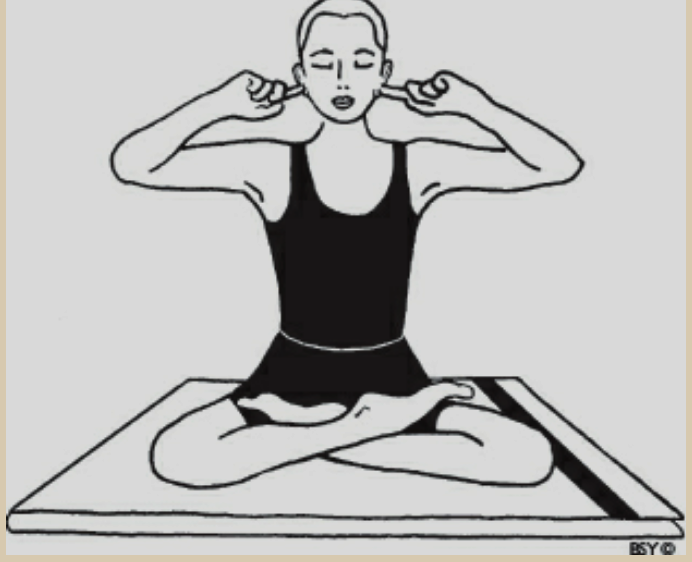
Bhramari Pranayama (humming bee breath)

Technique 1 


Sit in a comfortable meditation asana, preferably padmasana or siddha/siddha yoni asana with the hands resting on the knees in jnana or chin mudra. 

Close the eyes and relax the whole body. 

The lips should remain gently closed with the teeth slightly separated throughout the practice. This allows the sound vibration to be heard and felt more distinctly.

Raise the arms sideways and bend the elbows, bringing the hands to the ears. Use the index or middle fingers to plug the ears or the flaps of the ears may be pressed without inserting the fingers. 

Bring the awareness to the centre of the head, where ajna chakra is located, and keep the body absolutely still. 

Inhale through the nose. 

Exhale slowly and in a controlled manner while making a deep, steady humming sound like that of the black bee. 

The humming should be smooth, even and continuous for the duration of the exhalation. 

The sound should be soft and mellow, making the front of the skull reverberate. 

At the end of exhalation, the hands can be kept steady or returned to the knee and then raised again for the next round. 

The inhalation and exhalation should be smooth and controlled. This is one round.

Nadi Shodhana Pranayama - 4

Technique 4: Antar and Bahir Kumbhaka (internal and external retention) 

In this technique bahir kumbhaka or outer breath retention is introduced. Do not try to hold the breath outside for long at first, even though it may seem easy.

Nadi Shodhana Pranayama - 3

Technique 3: with Antar Kumbhaka (inner retention) 

In this technique antar kumbhaka or internal breath retention is introduced. The inhalation and exhalation should be silent, smooth and controlled. 


Stage 1

Begin with equal inhalation, inner retention and exhalation, using the ratio 1:1:1.

Close the right nostril and inhale slowly through the left nostril for a count of 5. 

At the end of inhalation, close both nostrils and retain the air in the lungs for a count of 5. 

Open the right nostril and exhale for a count of 5. 

At the end of exhalation, inhale through the right nostril for a count of 5, keeping the left nostril closed. 

Again, retain the breath for a count of 5 with both nostrils closed. 

Open the left nostril and exhale for a count of 5. 

This is one round using the ratio 5:5:5. 

Maintain constant awareness of the count and of the breath. 

Practise up to 10 rounds. 

Extension: After becoming comfortable with the count of 5:5:5, the breath and kumbhaka can be lengthened. Gradually increase the count by adding 1 unit to the inhalation, 1 unit to the retention and 1 unit to the exhalation. The count of one round will then be 6:6:6. 

When this has been perfected and there is no discomfort, increase the count to 7:7:7. 

Continue in this way until the count of 10:10:10 is reached. 

Do not force the breath. At the slightest sign of strain reduce the count. 


Stage 2

After perfecting the ratio of 1:1:1, increase the ratio to 1:1:2. 

Initially use a short count. Inhale for a count of 5, perform internal kumbhaka for a count of 5 and exhale for a count of 10. 

Extension

After mastering the count of 5:5:10, gradually increase the count by adding one unit to the inhalation, one unit to the retention and two units to the exhalation. 

The count of one round will then be 6:6:12. When this has been perfected and there is no discomfort, increase the count to 7:7:14. 

Gradually increase the count over several months of practice until the count of 10:10:20 is reached. 


Stage 3

Change the ratio to 1:2:2. 

Inhale for a count of 5, do internal kumbhaka for a count of 10 and exhale for a count of 10. 

Practise until the ratio is comfortable and there is no tendency to speed up the count during retention or exhalation due to shortness of breath. 

Extension: When this has been perfected, the count can be gradually increased by adding 1 unit to the inhalation, 2 units to the retention and 2 units to the exhalation. 

The count of one round will then be 6:12:12. 

In this manner, gradually increase the count to 10:20:20. 


Stage 4

The next ratio, 1:3:2, is intermediary. 

First reduce the count, inhale for a count of 5, do internal kumbhaka for a count of 15 and exhale for a count of 10. 

Practise until the ratio is comfortable and there is no tendency to speed up the count during retention or exhalation due to shortness of breath. 

Extension

When this has been perfected and there is no discomfort, the count can be gradually increased by adding 1 unit to the inhalation, 3 units to the retention and 2 units to the exhalation. 

The count of one round will then be 6:18:12. 

In this manner, gradually increase the count to 10:30:20. 


Stage 5: 

The final ratio is 1:4:2. 

Begin with 5:20:10. Once the ratio has been established, the count can gradually increase. 

Extension

Add 1 unit to the inhalation, 4 units to the retention and 2 units to the exhalation.

The count of one round will then be 6:24:12. 

In this manner, gradually increase the count to 10:40:20. 


Contra-indications

Technique 3 is not suitable for women in the later half of pregnancy. 

It is not recommended for people with heart problems, high blood pressure, emphysema or any major disorders. 

Stage 2 is not recommended for asthmatics. 


Benefits

The inner retention of breath, which characterizes technique 3, activates various brain centres and harmonizes the pranas. 

The benefits increase with the progression of the ratios. The ratio 1:4:2 is most widely recommended in the yogic texts. It gives profound psychological and pranic effects and is used as a preparation for kundalini awakening.